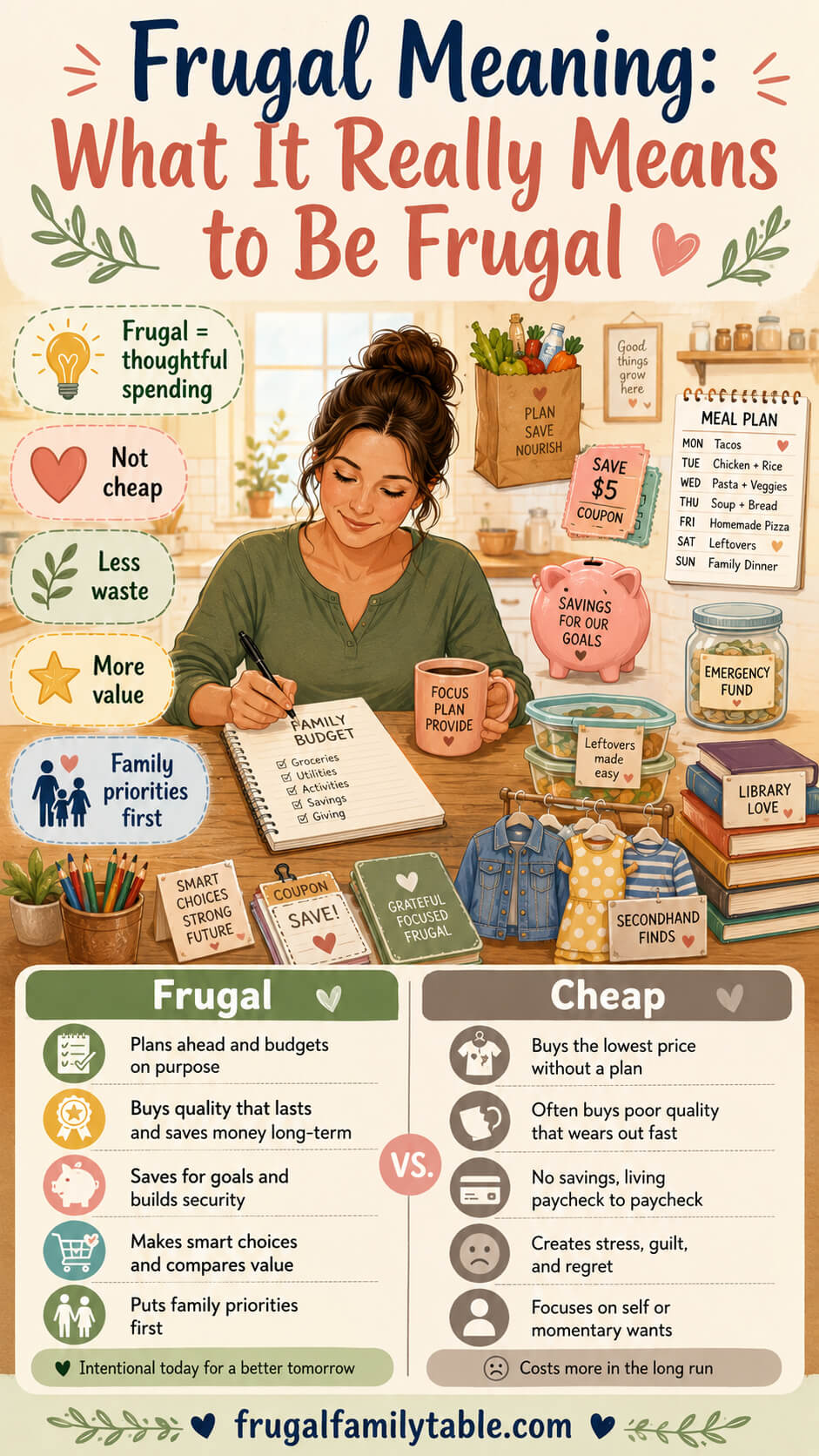
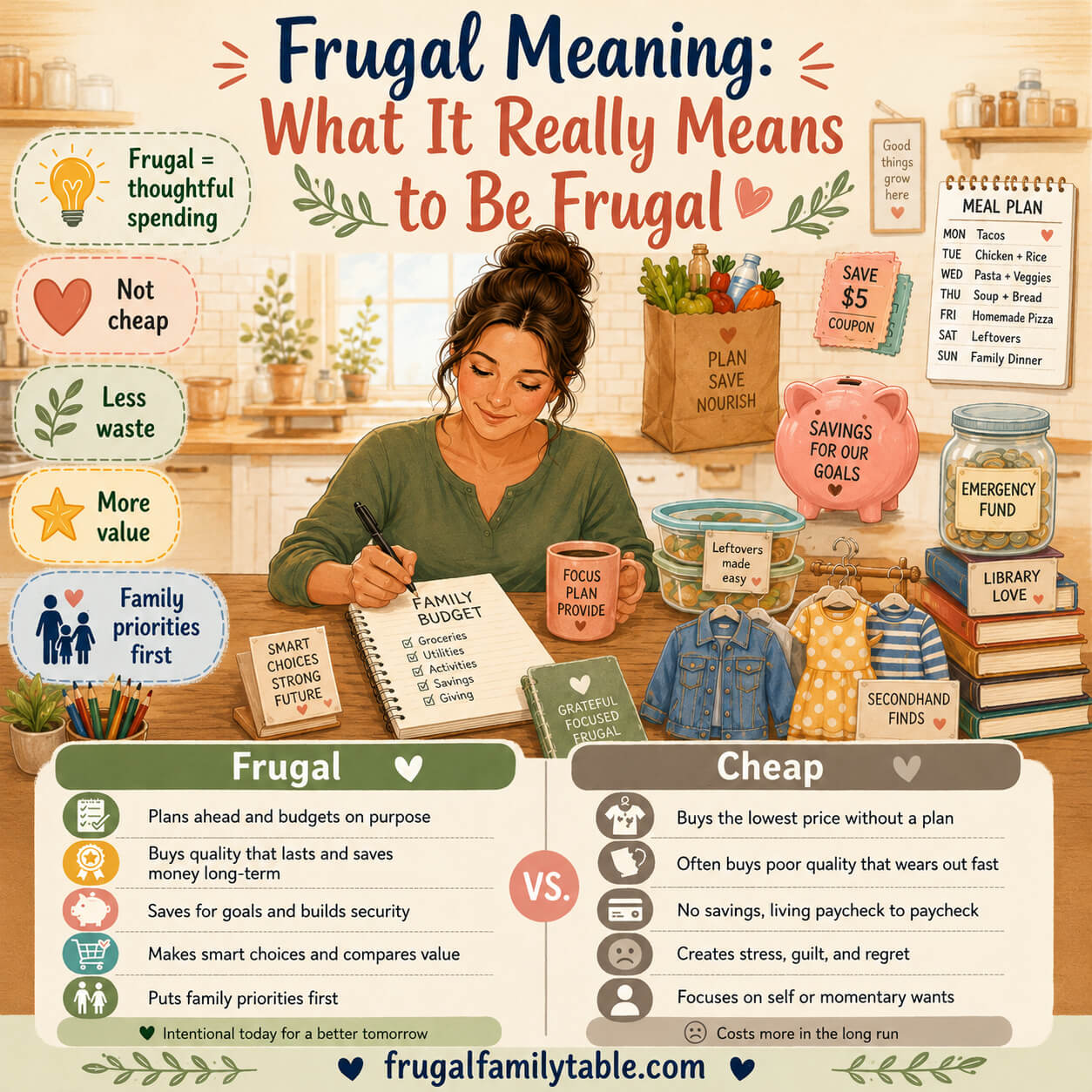
Frugal Meaning: What It Really Means to Be Frugal
Frugal means being careful and intentional with money, food, time, or other resources.
A frugal person avoids waste, spends thoughtfully, and puts money toward things that actually matter instead of things that don’t.
If you’re a mom trying to stretch the grocery budget, say yes to what matters, and still keep your family comfortable — frugal living can be a strength, not a sacrifice.
Frugal Definition in Simple Words
The Cambridge Dictionary defines frugal as being careful when using money or food.
Merriam-Webster groups it with words like thrifty, economical, and sparing — all pointing to the same idea:
using resources carefully, not recklessly.
In plain English, frugal means:
- You’re careful with money and resources.
- You avoid waste where you can.
- You choose value over impulse spending.
- You don’t spend carelessly — but you do still spend.
That last point matters. Frugal is not the same as refusing to spend money. It just means you think before you do.
Some real-life examples that probably already sound familiar:
- Grabbing the store-brand pasta sauce because it tastes the same and costs a dollar less.
- Packing your kid’s lunch instead of paying a few dollars a day for the school cafeteria lunch.
- Picking up a winter coat at the consignment shop because your seven-year-old will outgrow it by spring anyway.
None of that is deprivation. That’s just paying attention.
What Does Frugal Mean for a Mom on a Tight Budget?
For a lot of moms, frugal living is not a philosophy — it’s Thursday.
It’s looking at what’s in the fridge, figuring out three dinners, and making it work.
Frugal living for moms often looks like:
- Planning meals before you go to the store so you don’t buy things you won’t use.
- Comparing prices between brands before tossing something in the cart.
- Using leftovers on purpose — not just eating them reluctantly.
- Saying no to some things so there’s money left for what actually matters.
- Putting away $10 or $20 at a time, even when it feels small.
- Choosing free options — splash pads, library story hours, neighborhood parks — over paid events when the budget is tight.
You’re not alone in doing all of this. Most American families are figuring out the same puzzle.
And the fact that you’re thinking about it, planning, and making choices on purpose?
That already is frugal living. You might just not have been calling it that.
Frugal vs Cheap: What’s the Difference?
This comes up a lot — and it’s worth clearing up, because frugal and cheap are not the same thing.
| Frugal | Cheap |
|---|---|
| Focuses on value | Focuses only on the lowest price |
| Avoids waste | Avoids spending even when spending is needed |
| Can still be generous | May save money at someone else’s expense |
| Thinks long-term | Thinks only about today’s cost |
| Makes life simpler | Can make life harder or less fair |
Here’s how that plays out in real situations:
Frugal: You buy a good-quality winter coat on sale at the end of the season for next year. Cheap: You buy the cheapest coat you can find, and it falls apart in two months.
Frugal: You cook at home most nights and enjoy it. Cheap: You never let your family have a simple treat — not even pizza on a Friday — even when there’s room in the budget.
Frugal: You use coupons at the grocery store. Cheap: You stiff the server at a restaurant because you don’t want to leave a tip.
The difference is whether your spending choices are about value — or just about paying as little as possible, no matter what it costs the people around you or your own peace of mind.
Is Being Frugal a Good Thing?
Yes. Most of the time, genuinely yes.
Being frugal can help your family:
- Reduce financial stress (even a little breathing room changes things).
- Pay bills on time instead of scrambling.
- Build an emergency fund, even slowly.
- Stay out of debt or start paying it down.
- Make room in the budget for what matters most to your specific family.
- Show your kids what smart money habits look like — not through lectures, but just by letting them watch how you handle it.
Where it can go sideways is when frugality turns into guilt.
When every purchase feels like a failure. When you can’t let your kids have a birthday cake without doing the math out loud.
That’s no longer frugal — that’s anxiety wearing a budget spreadsheet.
Frugal is a tool. Like any tool, it’s useful when it fits the job and harmful when you can’t put it down.
Frugal Person Meaning
A frugal person is someone thoughtful, resourceful, practical, and patient with money.
They’re not usually swayed by trends or peer pressure to spend.
They think about whether something is worth what it costs — and they’re okay skipping it when it’s not.
Frugal people are not sad about this. Most of them feel good about it. There’s a certain satisfaction in not being jerked around by every sale sign or social media ad.
A frugal mom is not failing her family.
She’s often the person quietly making sure everyone has what they need — school supplies, a full fridge, doctor visits covered — while nobody else is paying attention to how that actually happens.
Frugal Lifestyle Meaning
A frugal lifestyle has nothing to do with being poor or being miserable.
It’s about making choices on purpose.
That can look like:
- Meal planning so nothing rots in the back of the fridge.
- Using the library instead of buying every book your kid wants.
- Buying secondhand when it makes sense (furniture, kids’ clothes, sports equipment).
- Canceling the subscriptions nobody actually uses.
- Keeping a simple family calendar so you plan activities that don’t cost much.
- Repairing things before replacing them — when it’s actually worth it.
- Setting aside money for emergencies so one bad week doesn’t wreck a whole month.
A frugal lifestyle is not one-size-fits-all.
Some families keep the streaming service because that’s their Friday night together.
Some skip the gym membership and walk instead.
The point is you’re deciding — not just spending by default.
Everyday Frugal Examples for Families
Here’s a list you can actually use:
- Plan meals around what’s already in the pantry before writing your grocery list.
- Buy generic or store-brand for items where the quality is the same (canned goods, cleaning products, spices).
- Use grocery curbside pickup — it’s easier to stick to your list when you’re not walking the aisles.
- Keep a small gift closet. Stock it when things go on clearance, so you’re ready for birthday parties.
- Buy kids’ clothes at consignment stores. They outgrow everything anyway.
- Use the public library for books, movies, activity kits, and kids’ events — often free.
- Make coffee at home instead of stopping at a coffee shop. Skipping even a few drive-through coffees a week adds up faster than you’d think.
- Choose free parks, community events, and splash pads for family activities.
- Cook double batches and freeze half. Future-you will be grateful.
- Go through your subscriptions once a year and cancel anything you’re not actively using.
- Review your phone, internet, and insurance bills annually. Companies often have better rates available — they just don’t tell you.
- Talk to your kids about the difference between needs and wants. Not as a lecture — just in real conversation.
Frugal Synonyms
Words that mean something similar to frugal:
- Thrifty — careful with money, usually with a positive tone. Most people treat thrifty and frugal as interchangeable.
- Economical — getting good value for what you spend.
- Careful — paying attention and not being careless with money.
- Practical — focused on what works over what looks impressive.
- Resourceful — good at making the most of what you have.
- Budget-conscious — spending within a plan.
- Prudent — sensible and steady with decisions.
“Stingy” and “miserly” are different. They’re negative for a reason — they describe someone who hoards money at everyone else’s expense.
That’s not frugal. That’s just unpleasant.
Frugal Antonyms
The opposite of frugal:
- Wasteful
- Extravagant
- Lavish
- Careless
- Spendthrift
- Excessive
One thing worth saying: the opposite of frugal is wasteful — not generous. You can be frugal and still be kind, giving, and generous. Those things are not in conflict.
How to Be Frugal Without Feeling Deprived
The way frugality goes wrong for a lot of families is when it becomes a wall of “no” with no room for anything good.
That’s not sustainable, and it’s not the goal.
A few things that help:
Decide what your “yes” is before you figure out the “no.” If family movie night matters, protect that in the budget first. Then cut somewhere it matters less.
Keep one small treat category. Even $20 a month for something that feels like a treat — a nice coffee, a used book, a plant — makes the whole system feel less punishing.
Don’t cut every joy from the budget. A little intentional spending on things that actually make your family happy is not a failure. It’s the point.
Focus on progress, not perfection. You’re not going to do this perfectly every week. Nobody does. A small choice in the right direction still counts.
If Friday pizza night matters to your kids, maybe you keep it — but make pizza at home or move it to twice a month instead of every week.
That’s frugal. That’s not deprivation.
Common Myths About Being Frugal
Myth: Frugal means cheap. No. Cheap means avoiding spending even when it’s the right call. Frugal means choosing wisely.
Myth: Frugal means you never spend money. Also no. Frugal people spend money. They just spend it on things that are worth it to them.
Myth: Frugal living is only for people with low income. Plenty of high earners are frugal. Plenty of people with tight budgets spend carelessly. Frugality is a habit, not an income bracket.
Myth: Frugal moms are depriving their kids. A mom who plans, saves, and shows up with what her kids need is giving them a stable home. That’s it.
Myth: Frugal living has to be boring. Library trips, free concerts in the park, backyard movie nights, cooking together — none of that is boring. Low-cost and boring are two completely different things.
Quick Frugal Meaning Summary
- Frugal means careful and intentional with money or resources.
- Frugal is generally a positive word.
- Frugal is not the same as cheap.
- A frugal person focuses on value, not just low prices.
- For moms, frugal living can help stretch the family budget while protecting what actually matters to your family.
FAQs About Frugal Meaning
What does frugal mean?
Frugal means being careful and intentional with money or resources — avoiding waste and choosing value over unnecessary spending.
Does frugal mean cheap?
No. Cheap usually means avoiding spending at any cost, sometimes at others’ expense. Frugal means spending thoughtfully and getting good value. Someone who buys quality on sale is frugal. Someone who tips poorly to save money is cheap.
Is frugal a compliment?
Generally yes. Being called frugal usually means someone sees you as careful, practical, and financially responsible. It’s not an insult.
What is a frugal person?
A frugal person is someone who thinks before spending, avoids waste, looks for value, and makes intentional choices with money. They’re not ruled by trends or impulse.
What is an example of being frugal?
Buying your kid’s school clothes at a consignment shop because they’ll outgrow them in a few months. Buying store-brand cereal. Packing lunch instead of buying it. Cooking a double batch and freezing half.
What is a frugal lifestyle?
It’s a way of living built around intentional spending — meal planning, using the library, buying secondhand, skipping unused subscriptions, and saving for emergencies. It’s not about being miserable. It’s about making choices on purpose.
What is the opposite of frugal?
Wasteful. Also: extravagant, careless, spendthrift. Note that “generous” is not the opposite of frugal — frugal people can be very generous.
What is the difference between frugal and thrifty?
They’re close. Thrifty often suggests actively finding bargains and making the most of resources. Frugal is slightly broader — it’s about careful, intentional use of money overall. In everyday conversation, most people use them interchangeably.
Can you be frugal and still enjoy life?
Yes. Frugality is about spending with intention — not about removing all pleasure from your budget. If something genuinely matters to your family, a frugal approach might mean finding a cheaper version of it, not eliminating it.
Wrapping Up
Being frugal is not something to apologize for. It means you pay attention. You plan. You protect your family’s money instead of letting it disappear without a second thought.
The frugal meaning comes down to being careful with what you have so you can use it well.
For moms juggling groceries, school supplies, bills, and everything in between — that kind of steady thinking is what keeps a family afloat.
And on the weeks it clicks?
It feels really good.
Small choices add up. You’re not alone in making them.
And frugal can still feel full.