20/30/50 Budget Rule: How the 50/30/20 Budget Works for Moms on a Tight Budget
Grocery prices went up again. Rent is still too high. Childcare costs more than your car payment. Gas doesn’t seem to go down, and the bills just keep coming.
If you’re trying to hold your family’s finances together, budgeting isn’t just a good idea — it feels urgent. And exhausting.
So if you typed “20 30 50 budget” into a search bar, you’re probably looking for something that actually makes sense of the mess. Good news: you’re in the right place.
You’re most likely thinking of the 50/30/20 budget rule, which is the same thing just written in a different order.
It’s one of the simplest budgeting methods out there, and it really can work for everyday family life — even when money is tight.
It’s not magic. It won’t fix everything overnight. But it gives you a real place to start.
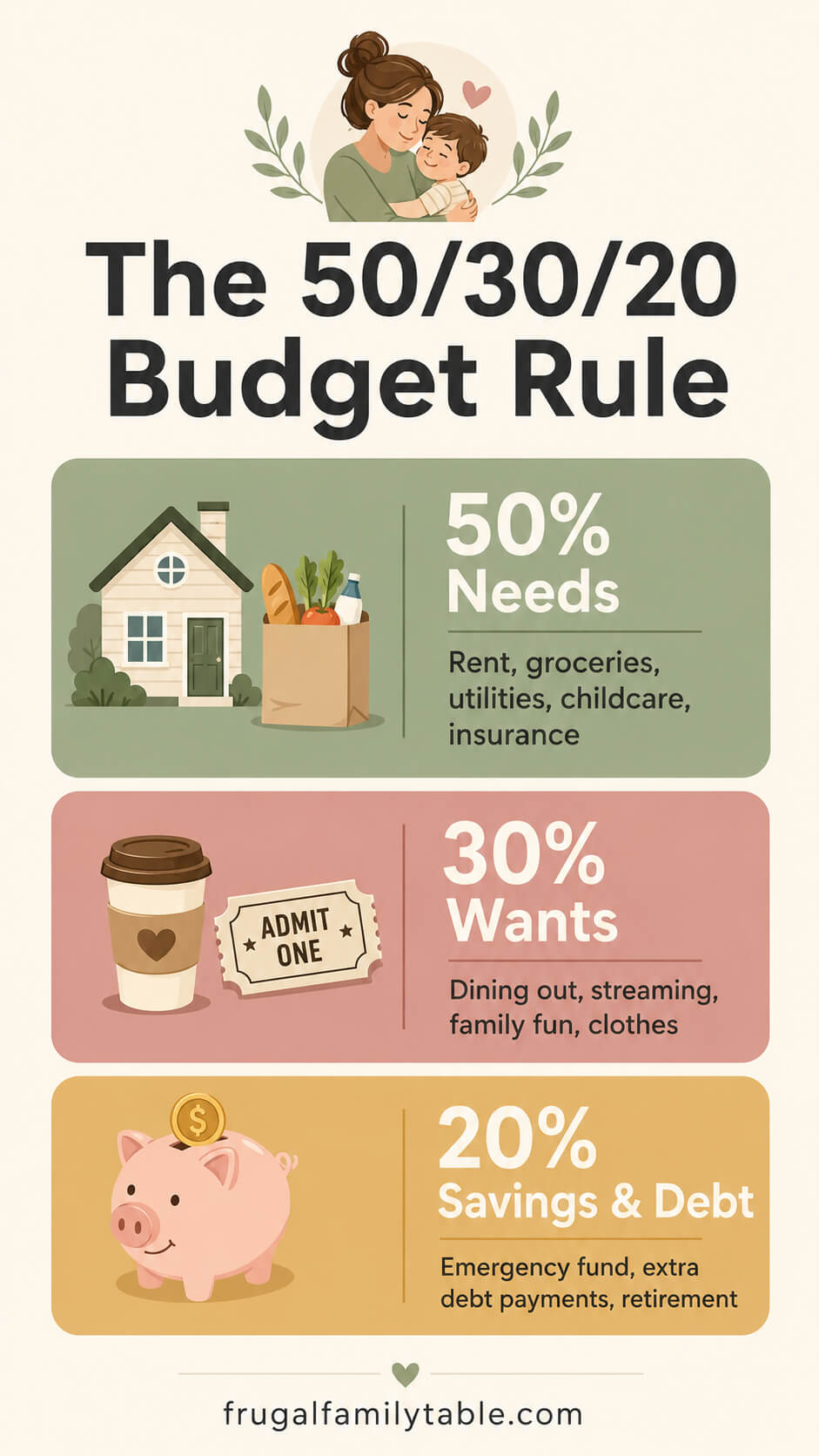
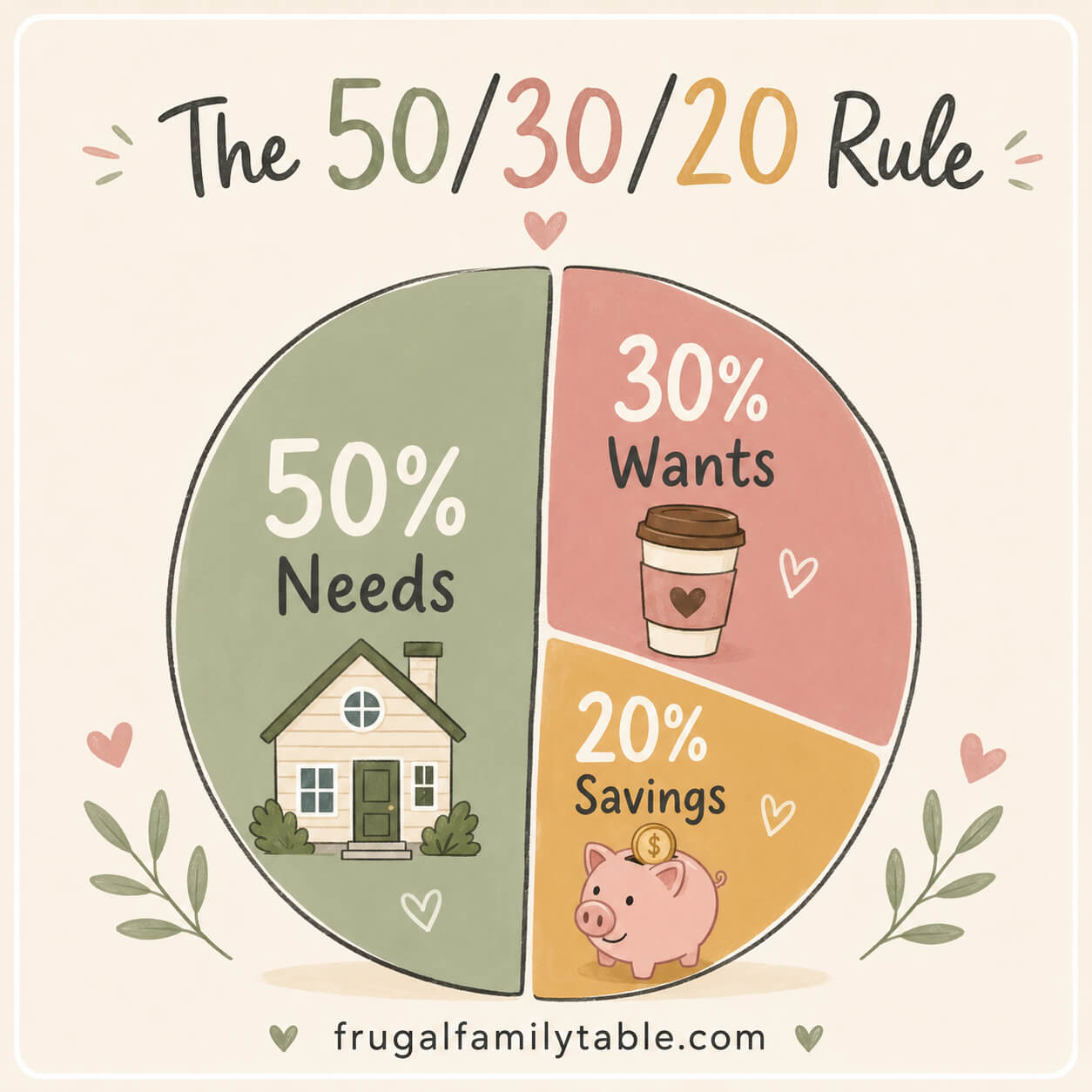
Quick definition: The 20 30 50 budget usually refers to the 50/30/20 budget rule, a simple way to divide your after-tax income into three categories: 50% for needs, 30% for wants, and 20% for savings or extra debt payments.
What Is the 20 30 50 Budget?
The 20 30 50 budget is another name for the 50/30/20 budget rule — people just write the numbers in a different order sometimes. Both phrases point to the same idea.
Here’s how it breaks down:
- 50% of your take-home pay goes toward needs
- 30% goes toward wants
- 20% goes toward savings and extra debt payments
The rule is built around your take-home pay, not your gross salary.
That’s the money you actually see in your bank account after taxes, health insurance, and other deductions come out.
Not what’s on your offer letter. What actually lands.
For a mom juggling rent, kids, groceries, and everything else, having just three buckets to think about makes the whole thing a lot more manageable.
Is It the Same as the 50/30/20 Budget Rule?
Yes. They’re the same rule.
People search for it in different ways — “20 30 50 budget,” “50 30 20 budget,” “needs wants savings budget” — and they all lead to the same place.
The order doesn’t matter.
What matters is understanding what each category covers and how to make it work for your actual life.
The Basic Formula
| Category | Percentage | Examples |
|---|---|---|
| Needs | 50% | Rent, mortgage, groceries, utilities, gas, insurance, childcare |
| Wants | 30% | Eating out, streaming, family outings, non-essential shopping |
| Savings & Debt | 20% | Emergency fund, retirement, extra credit card payments, savings goals |
How the 50/30/20 Budget Rule Works
Step 1 — Start With Your Take-Home Pay
Take-home pay is what hits your bank account after everything is taken out.
Federal and state taxes, Social Security, Medicare, health insurance premiums — all of that is already gone. What’s left is your number.
If you’re paid twice a month, add those two checks together.
If your income comes from multiple places — a part-time job, a side hustle, child support — add those in too.
Just be careful with child support or freelance income if it varies; use a realistic average, not a best-case number.
If your income changes month to month, try using the lowest amount you reliably bring in. It’s easier to have money left over than to come up short.
Step 2 — Put 50% Toward Needs
Needs are the expenses that keep your household running.
Not the nice-to-haves — the actual can’t-skip-it stuff.
For most moms, this list looks something like:
- Rent or mortgage
- Groceries (basic, not the fancy stuff)
- Electricity, water, and gas bills
- A basic phone plan
- Car payment
- Gas to get to work and school
- Car insurance and health insurance
- Childcare you need so you can work
- Minimum payments on debt (credit cards, student loans)
- School lunch or basic school supplies
Here’s something important: if your needs are already over 50%, that doesn’t mean you failed.
It means the original rule wasn’t designed with the current cost of living in mind — or with your situation specifically.
A lot of American families are spending 60%, 70%, or even 80% on needs. You’re not doing it wrong.
We’ll talk about how to adjust below.
Step 3 — Put 30% Toward Wants
Wants are the things that make day-to-day life actually enjoyable — not just survivable.
Things like:
- Takeout or a sit-down dinner
- Coffee you didn’t make at home
- Streaming services (Netflix, Hulu, Disney+)
- Toys, treats, and little extras for the kids
- Family outings — the zoo, a movie, mini-golf
- Clothes you don’t technically need right now
- A haircut or manicure
- Holiday extras, birthday decorations, seasonal stuff
Wanting things isn’t a character flaw. You’re a person, not a machine.
The goal here is just to be intentional about it — know what you’re spending, decide if it’s worth it, and keep it from quietly eating your whole paycheck.
Step 4 — Put 20% Toward Savings and Extra Debt Payoff
This is the bucket that builds your future.
For moms on a tight budget, it can feel impossible. But even small amounts count.
Examples of what goes here:
- Emergency fund (even $10 at a time)
- A car repair fund so you’re not caught off guard
- A Christmas or birthday savings fund
- Extra payments on a credit card, beyond the minimum
- Extra student loan payments
- Retirement savings if your job offers a 401(k) match
- A medical expense fund
If you can only put $15 a month into savings right now, do that.
A small emergency fund is still an emergency fund. You’re building a habit, not just a balance.
50/30/20 Budget Examples for a Tight Family Budget
Example 1 — $3,000 Monthly Take-Home Pay
| Category | Formula | Monthly Amount |
|---|---|---|
| Needs | $3,000 × 50% | $1,500 |
| Wants | $3,000 × 30% | $900 |
| Savings/Debt | $3,000 × 20% | $600 |
On $3,000 a month, $1,500 for needs sounds reasonable until you realize rent alone in a lot of American cities is $1,200 to $1,500.
Add groceries, a car payment, and childcare, and you’re already over.
This is exactly why the rule needs to flex for real families.
It’s a guide, not a law.
Example 2 — $4,500 Monthly Take-Home Pay
| Category | Formula | Monthly Amount |
|---|---|---|
| Needs | $4,500 × 50% | $2,250 |
| Wants | $4,500 × 30% | $1,350 |
| Savings/Debt | $4,500 × 20% | $900 |
At $4,500 take-home, the breathing room gets a little better.
$2,250 for needs can cover housing in lower-cost areas plus childcare and groceries.
$900 toward savings and debt gives you real traction on an emergency fund or credit card balance.
Quick Formula You Can Use
Copy these into your phone notes:
- Needs = monthly take-home pay × 0.50
- Wants = monthly take-home pay × 0.30
- Savings/debt = monthly take-home pay × 0.20
What Counts as Needs vs. Wants for Moms?
Needs vs. wants sounds simple until you’re actually sitting down trying to sort your credit card statement.
The line gets blurry fast.
Common Needs
- Housing (rent or mortgage payment)
- Basic groceries — food your family needs to eat
- Electricity, gas, and water bills
- Childcare you need so you can go to work
- Transportation — car payment, gas, or bus fare
- Insurance (health, car, renters, or homeowners)
- Prescriptions and necessary medical care
- Minimum payments on all debt
- Basic school supplies, lunch, and required fees
Common Wants
- Restaurant meals and takeout
- Premium streaming services beyond one or two basics
- Extra toys or gadgets
- New clothes when the current ones still work
- Salon visits (hair, nails)
- Family entertainment beyond free options
- Home decor and non-essential upgrades
- Subscription boxes
The Tricky Gray Areas
Some things fall in between, and that’s okay.
Groceries: The basics are a need. But the premium snacks, the specialty items, the convenience meals — those are partly wants. You don’t have to track every cracker. Just notice if your grocery spending has a lot of stuff in it that isn’t really food.
Your car: In most American suburbs and rural areas, a car is absolutely a necessity. But trading up to a nicer or newer car than you functionally need? That part is a want.
Internet: If you work from home, help your kids with online schooling, or need it for job searching — need. If it’s entirely for entertainment, it’s closer to a want.
Kids’ activities: Soccer, dance, swimming lessons — these sit somewhere in the middle. They’re not survival needs, but they matter for kids’ development and your sanity. Nobody’s taking points off for signing their kid up for soccer.
There’s no right answer. Do what works for your kid and your wallet.
What if Your Needs Are More Than 50%?
Many American families right now can’t keep their needs under 50%.
Rent has gone up. Childcare is brutally expensive. Groceries cost more. Medical bills pile up. Car payments are higher than they used to be.
If you’re spending 60% or 70% on needs, you’re not bad at budgeting.
You’re dealing with a cost-of-living reality that the original rule didn’t account for.
Guilt won’t move the numbers. Adjusting the percentages to match your actual life will.
Try a Realistic Version of the Rule
Some adjusted versions that work for tight budgets:
- 60/20/20 — 60% needs, 20% wants, 20% savings or debt
- 70/20/10 — 70% needs, 20% wants, 10% savings or debt
- 80/10/10 — 80% needs, 10% wants, 10% savings or debt (this is for true survival mode, temporarily)
If credit card debt has high interest, it makes sense to pull from the “wants” bucket and put more toward debt payoff.
You’ll save money on interest even if it means fewer restaurant nights for a few months.
If you have no emergency fund, start with a small goal — $500 is enough to cover a lot of minor crises. $1,000 handles most car repairs.
You don’t need a full three-month fund before you start feeling safer.
Small Changes That Can Help
These aren’t dramatic lifestyle overhauls.
Just small tweaks that can shift a few dollars from one bucket to another:
- Meal plan before you go grocery shopping — it cuts waste and impulse buys
- Use store pickup to avoid wandering the aisles
- Go through subscriptions and cancel what you haven’t used in two months
- Plan one or two free or cheap family outings each month instead of paid activities
- Buy kids’ clothes and gear secondhand — consignment stores, Facebook Marketplace, ThredUp
- Build separate sinking funds for predictable costs like Christmas, back-to-school shopping, and car registration
- Set up a small automatic transfer to savings the day after payday — even $10
- Look at your bills once a month; insurance, phone plans, and internet are all negotiable
50/30/20 Budget vs. Other Budgeting Methods
50/30/20 Budget vs. Zero-Based Budget
| Method | Best For | Pros | Cons |
|---|---|---|---|
| 50/30/20 Budget | Beginners and busy families | Simple and flexible | Less detailed |
| Zero-Based Budget | People who want every dollar assigned | Very organized | Takes more time |
Zero-based budgeting means every dollar has a job — income minus all assigned spending equals zero.
It’s thorough but takes more time to set up and maintain.
If you’re already stretched thin on time, the 50/30/20 rule is easier to stick with.
50/30/20 Budget vs. Cash Envelope System
The cash envelope system means withdrawing cash and dividing it into physical envelopes — one for groceries, one for gas, one for fun money, and so on.
When the envelope is empty, spending stops.
It works really well for categories where you tend to overspend.
Groceries and eating out are the two big ones for most families.
You can absolutely use envelopes for those categories while using the 50/30/20 rule for everything else.
50/30/20 Budget vs. Pay Yourself First
“Pay yourself first” means moving money to savings the moment your paycheck hits — before bills, before groceries, before anything.
It’s the opposite of saving whatever’s left at the end of the month (which is usually nothing).
You can stack this with the 50/30/20 rule easily.
On payday, move your 20% savings amount first. Then handle needs and wants with what’s left.
If that sounds scary with your current income, start with $10 or $25. The habit is the point.
How to Start a 20 30 50 Budget This Week
1. Write Down Your Take-Home Income
Add up all the money coming in this month — your paycheck(s), any side income, child support you actually receive regularly.
Use the real number, not what you hope for.
2. List Your Bills and Regular Expenses
Go through your bank statements and credit card history from the past two or three months.
Write down everything — rent, phone, car payment, subscriptions, childcare, groceries, gas, and anything else that shows up.
Don’t skip the irregular stuff either: school fees, doctor copays, car maintenance, Amazon orders. Those count.
3. Sort Everything Into Needs, Wants, and Savings/Debt
Use the categories above.
When you’re not sure, ask yourself: “Could my family function without this?”
If yes, it’s a want. If not, it’s a need.
4. Compare Your Spending to the 50/30/20 Rule
Do the math.
Is needs eating 65% of your income? Are you at 5% because you’ve already cut everything? Are the savings at zero?
Just knowing where your money actually goes is useful.
Most people are surprised.
5. Adjust Gently
Don’t try to fix everything this week. Pick one thing to shift. Maybe it’s canceling one subscription.
Maybe it’s doing one less takeout night.
Small changes that you can actually keep are worth more than a perfect budget you abandon in two weeks.
6. Review Every Month
Your family’s expenses change constantly — especially with kids.
School costs, medical stuff, sports seasons, holiday spending — it all moves around.
A quick monthly check-in (even 15 minutes) keeps you from drifting too far off track.
Common Mistakes to Avoid
Using Gross Income Instead of Take-Home Pay
If you make $60,000 a year, that’s not $5,000 a month to budget with.
After taxes and deductions, it might be closer to $3,800 or $4,000, depending on your state and benefits.
Always use what actually lands in your account.
Feeling Guilty When the Numbers Don’t Fit
The 50/30/20 rule was designed before rent and childcare prices got this high.
Needing 65% for needs isn’t a personal failure — it’s a math problem with real-world causes.
Work with your numbers, not against them.
Calling Every Want a Need
It’s tempting to move things into the “needs” pile to make yourself feel better about spending.
Streaming TV is a want. Takeout three nights a week is a want.
Being honest here is what makes the budget useful.
Forgetting Irregular Expenses
Car registration. School pictures. That dentist appointment you’ve been putting off. Annual subscriptions.
These are real costs that blow budgets when people forget to plan for them.
Set aside a small amount each month in a sinking fund so they don’t catch you off guard.
Not Planning for Kids’ Costs
Kids are expensive in unpredictable ways.
Field trip fees, birthday party invitations, outgrown shoes, sports equipment — it adds up faster than you expect.
Keep a small “kid stuff” buffer in your budget every month.
Giving Up Too Soon
The first month of any budget is the hardest.
You’ll miss expenses. You’ll go over in a category. You’ll feel like it’s not working.
That’s completely normal.
The second and third months get easier as you figure out your real numbers.
Give it at least 90 days before you decide it isn’t for you.
Simple Monthly Budget Template
| Budget Item | Amount |
|---|---|
| Monthly take-home pay | $ |
| Needs target (50%) | $ |
| Wants target (30%) | $ |
| Savings/debt target (20%) | $ |
| Actual needs spending | $ |
| Actual wants spending | $ |
| Actual savings/debt | $ |
| What needs adjusting? | $ |
How to use it: Fill in your take-home pay at the top, then calculate the targets. At the end of the month, fill in what you actually spent. Compare the two columns. If needs are way over target, look at whether any of those expenses can be reduced. If wants are under, great — consider moving some of that to savings. This doesn’t have to be fancy. A piece of paper on the fridge works.
Is the 50/30/20 Budget Good for Moms on a Tight Budget?
Honestly? It depends.
It’s a genuinely useful starting point, especially if you’ve never really tracked your spending before.
It’s simple, it covers the main categories, and it gives you something concrete to compare against.
But it’s not a perfect rule. It was built around incomes and cost-of-living levels that don’t match what a lot of American families are actually dealing with right now.
If rent is $1,800 and take-home pay is $3,500, the 50% target is already blown before you buy a single bag of groceries.
The most honest way to use it: treat it as a guide, not a grading system.
Use the percentages to see where your money is actually going.
Adjust the splits to fit your life. And don’t let the “right” numbers make you feel like your budget is wrong.
FAQs About the 20 30 50 Budget
Is it 20/30/50 or 50/30/20?
Both names refer to the same rule. The official version is usually called the 50/30/20 budget rule (needs, wants, savings), but people search for it in all kinds of orders. If you see “20 30 50 budget,” it means the same thing.
Is the 50/30/20 rule based on gross income or take-home pay?
Take-home pay. That’s the money in your bank account after taxes and deductions. Using your gross salary will make your categories look bigger than they actually are, and your budget won’t reflect reality.
What if I can’t save 20%?
Save what you can. Even $10 a month is better than nothing, and it builds the habit. If your needs are eating most of your income right now, try an adjusted split like 70/20/10 and work toward increasing the savings percentage over time.
Does rent count as a need?
Yes, absolutely. Housing is a core need. The problem for a lot of families is that rent takes up a huge chunk of that 50% target on its own, leaving very little for everything else. That’s a real challenge, not a budgeting mistake.
Do groceries count as needs?
Basic groceries — yes. The food your family eats day to day is a need. Premium items, specialty products, and convenience foods start to blur into the wants territory. You don’t need to track every item, but it’s worth noticing if your grocery bill is climbing partly because of extras.
Are credit card payments part of needs or savings?
The minimum payment goes in needs, because skipping it has real consequences (late fees, credit damage). Any amount above the minimum goes in savings/debt — it’s extra progress on your debt, not a basic obligation.
Is the 50/30/20 budget realistic for families?
Sometimes. It works better for families with lower fixed costs (cheaper rent, no childcare). For families in high-cost cities or with young kids, the needs category almost always runs over 50%. The rule still has value as a reference point, but you’ll likely need to adjust the percentages.
What is a good budget for a single mom?
The same framework applies, but single moms often carry higher fixed costs with one income. An adjusted split — 60% or 65% needs, 20% wants, 15–20% savings/debt — may be more realistic. The priority is usually getting a small emergency fund started and keeping up with minimum debt payments before stressing about hitting exact percentages.
Can I use the 50/30/20 rule if my income changes every month?
Yes, but calculate it fresh each month based on what you actually earn. If December is a big month for tips or freelance work, you might hit the 20% savings target. In a slow month, even 5% is okay. You can also base your budget on your lowest typical month and treat anything extra as a bonus to throw at savings or debt.
Final Thoughts
Budgeting is not about being perfect. It’s not about hitting every target every month or feeling bad when something goes over.
It’s about knowing where your money is going so you can make better decisions — even small ones — when you have the chance.
If you came here looking for the “20 30 50 budget,” now you know it’s the same as the 50/30/20 budget rule: 50% needs, 30% wants, 20% savings and debt.
You know how to calculate it, what goes in each bucket, and how to adjust it when life doesn’t fit neatly into any percentage.
Here’s the only challenge worth taking on this week: write down your take-home pay. List what you spent last month. Sort it into the three categories.
Just that. See what the numbers tell you.
You don’t need a perfect budget. You need one that actually fits your life — your income, your kids, your bills.
That’s the one worth building.